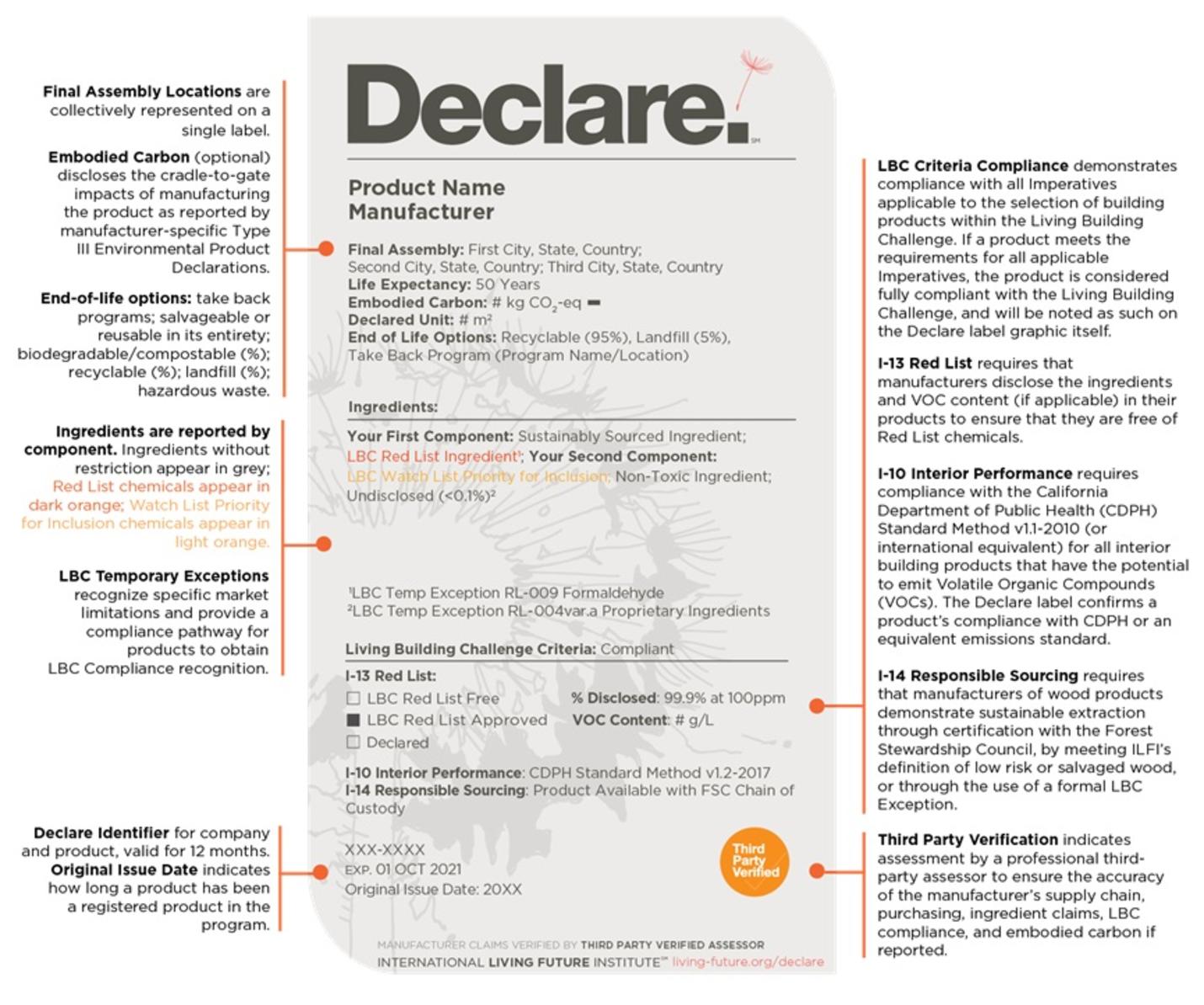
The intent of this Imperative is to set a baseline for transparency, sustainable extraction, support of local industry, and waste diversion for all projects. The requirements become more stringent with the rest of the Petal, however, with this Core imperative we introduce you to the Declare label, FSC certification and ways to approach waste diversion on your own project. We will describe the actual requirements for 7 Petal Living Certification when we come to the next imperatives in the following weeks: I13 Red List, I14 Responsible Sourcing, I15 Living Economy Sourcing and I16 Net Positive Waste.
A Declare label allows building products to be found on the Declare Database which was created by Living Future to drive transparency in the building industry. We are to specify a certain number of Declare labelled products on our LBC projects. There is also the Living Product Challenge label, by Living Future as well. It is for products that would like to be regenerative toward the environment and it is a step up from Declare.
In New Zealand, Fiona Caulfield is in charge of Declare labels, she can be reached on fiona.caulfield@living-future.org. For Australia, there is Nicola Smith, declare.australia@living-future.org, and for the rest of the world, try declare.support@living-future.org.
Living Future deems the FSC (Forest Stewardship Council) as holding the highest independent standards to ensure forests are managed in ways that respect people, nature, and future generations. The FSC Database is found here.
We approached the LBC requirement to divert construction waste material from the landfill by doing our own research of the local area for places where certain materials and items could be recycled and we gave this information to the contractor who were tasked with hitting the targets in I16 Net Positive Waste.
The Materials Petal of the Living Building Challenge posed significant challenges and required extensive effort during the project at Te Wānanga o Raukawa. Drawing upon years of research by Tennent Brown Architects, the project aimed to utilise local consultants, contractors, and materials suppliers to support the community and promote sustainable practices. Local businesses within close proximity supplied materials like paint and timber, fostering economic opportunities for overlooked suppliers and reducing environmental impact through minimised transportation.
Embracing a traditional approach, the project prioritised the use of Radiata Pine due to its sustainability, quick growth, and carbon-sequestering properties. This emphasis on Radiata Pine extended to various aspects of the construction process, including pre-fabrication enabled by a Virtual Design and Construction (VDC) consultant to minimise wastage. Structural Engineered Wood Products like Glulam and LVL replaced steel in primary and secondary structural components, while Thermally Modified Timber Products were used for cladding and decking, offering sustainable alternatives to traditional materials.